
 Free launch edition
Indonesia's public charging network, mapped
We counted 5,766 public chargers across 23 operators. Most are slow, three quarters are on Java, and the typical station has one or two chargers.
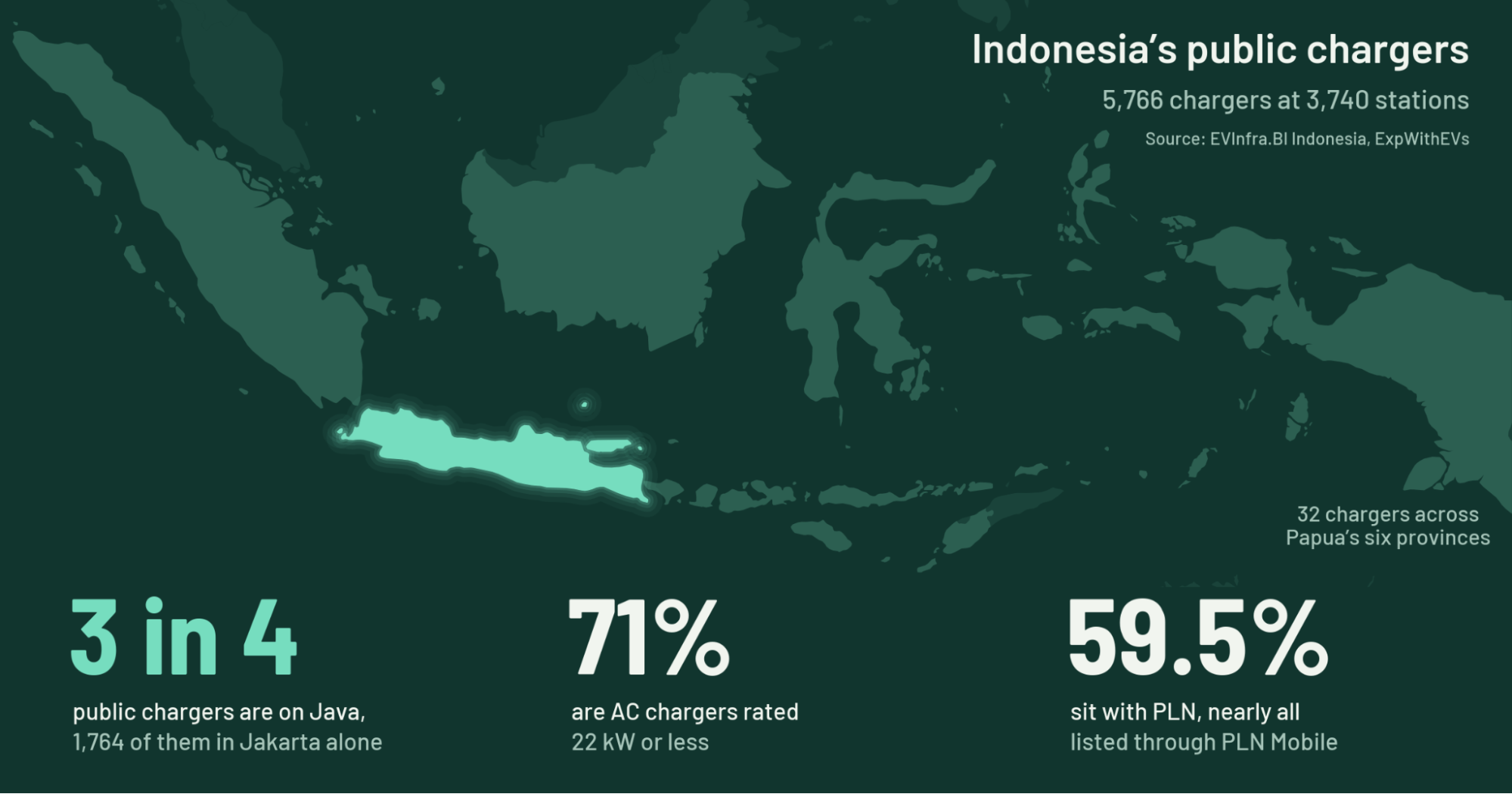
Indonesia spreads across more than 17,000 islands and 38 provinces, and every one of those provinces now has at least one public charger. Beyond that shared starting point, however, the network looks very different from place to place. In this report, our first on the country, we examine how that network has taken shape, drawing on 5,766 public chargers that we counted one by one from the networks of 23 charge point operators. Based on this data, we describe the size of the network, the connectors and power it offers, where its chargers are located and who runs them, before considering what these patterns mean for drivers.
The data covers publicly accessible chargers only and was compiled through manual data entry from the networks of all 23 charge point operators, with a cut-off of 31 August 2026.
Welcome to ExpWithEVs! We are an independent EV charging infrastructure research company. We specialise in collecting data and insights from the developing world.
We've been writing about the Indian market for a few years. Today we start covering other developing markets - Indonesia, Thailand, Malaysia, Brazil and Mexico. Make sure to sign up to receive the updates in your inbox.
We are an ad-free and sponsorship-free platform. Our work is supported by our data consultancy projects and by members like you. Please consider becoming a paying member. You can also share this post with your friends and colleagues.
We are present at EVChargeLive in Jakarta on November 11 & 12! Say hello.
The network at a glance
Those 5,766 chargers are spread across 3,740 stations and offer 7,204 connectors between them.
Stations also tend to be small, with about one and a half chargers and two connectors at a typical site. Station size matters for reliability as much as for capacity, because at a site with only one charger, a single fault or a short queue leaves the driver with no other charger to use.
If every SPKLU (Stasiun Pengisian Kendaraan Listrik Umum, Indonesian for public EV charging station) ran at full power at once, the network would draw about 230 MW, around a fifth of Bali's recorded peak of about 1,100 MW over Christmas and New Year in 2024-25.
Connector Types
CCS2, CHAdeMO and GB/T are fast / DC charging connectors, whereas Type 2 is slow / AC charging connector.

The fast chargers (CCS2, CHAdeMO and GB/T) usually have higher number of connectors at charging stations compared to only Type 2 chargers. Indonesia sees a dominance of CCS2 connectors. CHAdeMO and GB/T make up under 1% of the chargers in Indonesia.
Where a CCS2 charger shows more than two connectors, it is usually one power cabinet feeding several dispensers.
The CHAdeMO network supports older Japanese cars like the Nissan Leaf. The GB/T fast chargers serve few cars with GB/T sockets like Wuling's Binguo EV and Cloud EV.
Approximately 70% of PLN's DC network has dual CCS2 chargers. For Voltron and iGreen+, it is 85% and 100% respectively.
PLN and PLN Mobile have ~350 fast chargers with a single CCS2 connector, under 30% of their DC network. CPOs like Casion, BuzzEV and Parking Plus have more single CCS2 connector chargers than dual CCS2 connector chargers at 56%, 76% and 65% of their DC network respectively.
CPOs like Hyundai and Wuling are the largest networks with only Type 2 charging infrastructure. BlueCharge, Cazgo, Otopods and Mercedes-Benz are smaller CPOs with only Type 2 charging infrastructure. Only three CPOs have dual Type 2 chargers: Starvo, Astra Otopower and Stroom.
Geographical spread
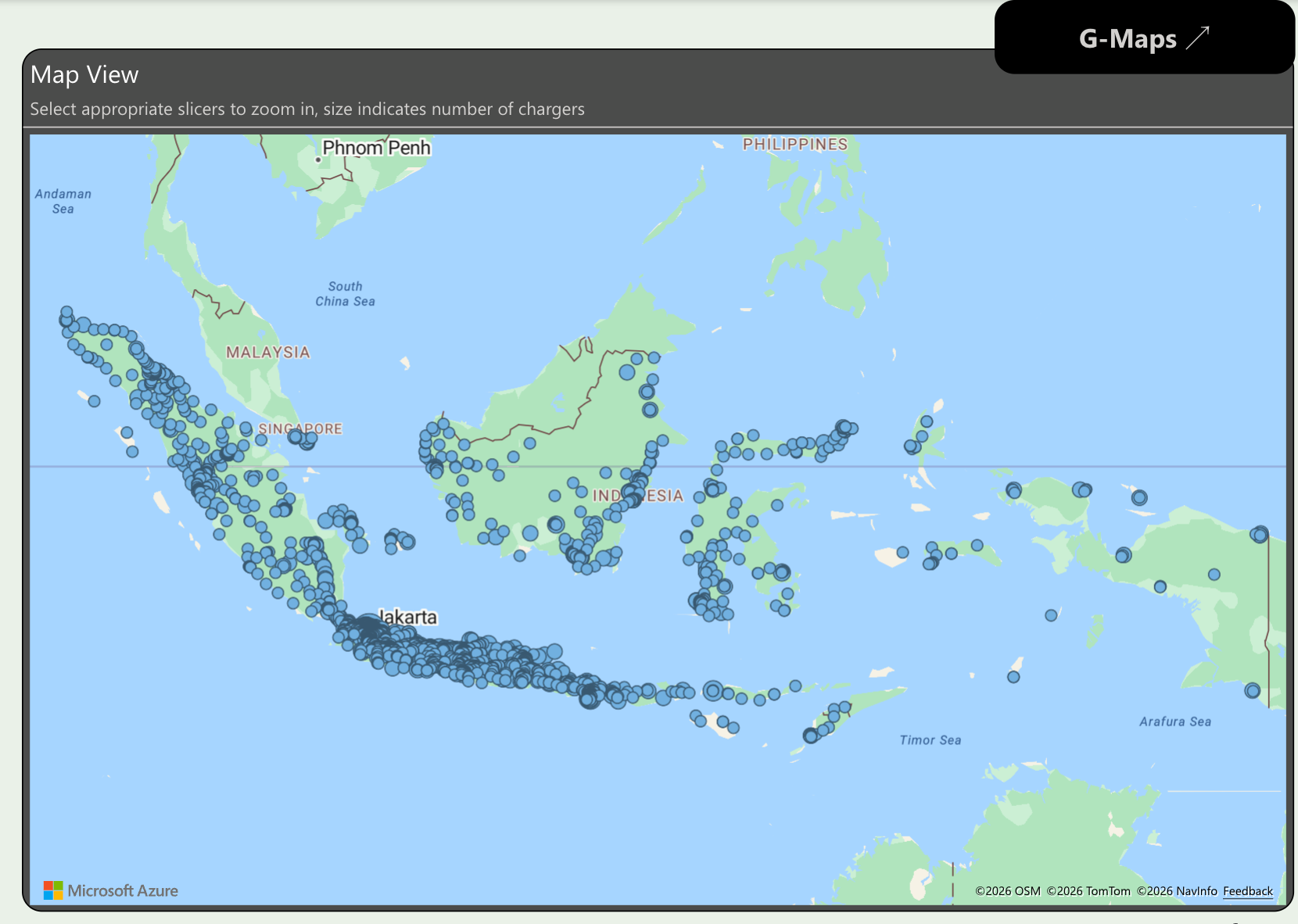
The map shows chargers packed along the full length of Java, with smaller clusters in Bali, along Sumatra and around the main cities of Kalimantan and Sulawesi. Further east, the network thins to a handful of points.
Java holds about three quarters of all public chargers, and most of these are located in and around the capital. Jakarta alone has 1,764 chargers, West Java has 1,100 and Banten has 639, which means that the three provinces of greater Jakarta account for about 60 per cent of the national total. Elsewhere on the island, East Java has 475 chargers, Central Java 393 and Yogyakarta 55.

Beyond Java, Bali leads with 218 chargers, followed by North Sumatra with 156. Sumatra’s ten provinces have 591 chargers between them, and Kalimantan has 232, of which 83 are in East Kalimantan, where the new capital, Nusantara, is under development. Sulawesi has 170 chargers, West and East Nusa Tenggara have 89 between them, and the eastern provinces from Maluku to Papua have only 57 in total, including a single charger in Highland Papua.
CPO Distribution
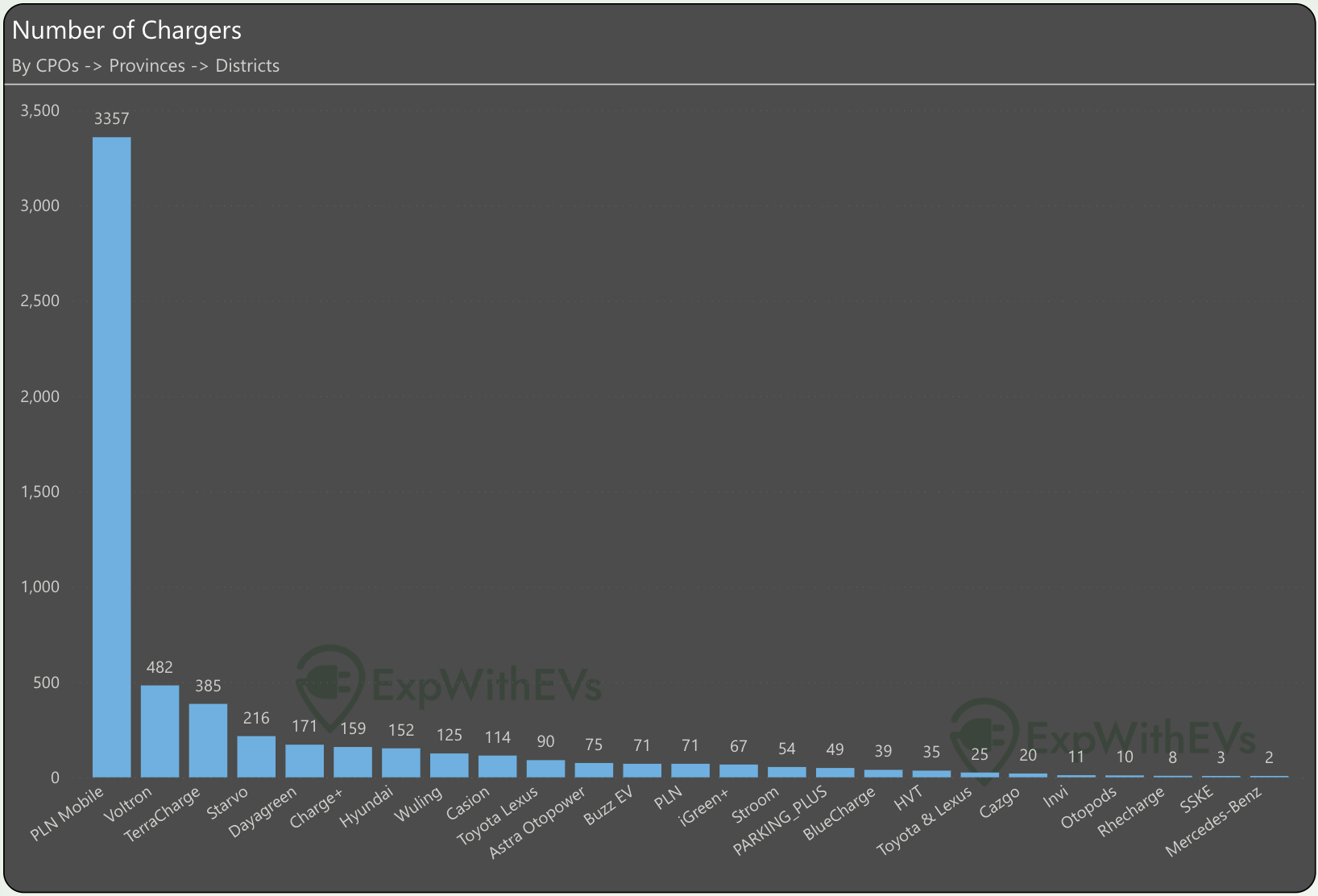
PLN, the state electricity company, accounts for 3,428 chargers, or 59.5 per cent of the national total. Almost all of these, 3,357 in total, are listed through its PLN Mobile app, which also lists sites built with partners. Voltron is the next largest operator with 482 chargers, followed by TerraCharge with 385, Starvo with 216, Dayagreen with 171 and Charge+ with 159. Together, PLN and these five networks hold about 84 per cent of all public chargers, which leaves the remaining 17 operators to share about one charger in six.
When operators are grouped by type, private charge point operators run 34 per cent of chargers, while carmaker networks, such as those of Hyundai, Wuling and Toyota, account for about 6 per cent. The Hyundai and Wuling networks are built entirely from 7 kW chargers, which suggests that they are not designed for drivers on longer journeys.
Charger Rating
Public chargers fall into two groups that work in different ways. AC chargers supply alternating current, which the car’s own onboard charger converts before it reaches the battery, and as a result the charging speed depends as much on the car as on the charger. DC chargers, on the other hand, carry out that conversion themselves and feed the battery directly, which allows them to run at 50 kW and well beyond.
Indonesia’s network leans heavily towards AC. About 4,100 of the 5,766 public chargers, or seven in ten, are AC units rated between 7 and 22 kW, while about 1,700 are DC chargers rated from 20 kW up to 720 kW. In practice, a 22 kW AC charger can take several hours to fill a typical battery, and since many cars accept only 7 to 11 kW on AC, they often charge more slowly still. A 120 kW DC charger, by contrast, can deliver most of a charge in under an hour.

Most of Indonesia’s public chargers sit at the lower end of the power range. The most common rating is 22 kW, shared by more than 3,000 chargers, or over half the network, and about one charger in six is rated at 7 kW. Among DC chargers, the most common rating is 120 kW, with 403 units, followed by 60 kW and 50 kW.
When the network is measured by installed power rather than by count, however, the picture changes considerably. AC chargers make up about 71 per cent of the network but supply only about a third of its installed power, which means that the 29 per cent of chargers that use DC carry about two thirds of it. The concentration is sharpest at the top of the range. Chargers between 60 and 150 kW make up 15 per cent of the network but 36 per cent of its power, and the 261 chargers rated above 150 kW make up under 5 per cent of the network but 23 per cent of its power.
The split between slow and fast charging also runs along operator lines. PLN Mobile accounts for about 1,870 of the 22 kW chargers, roughly three in five of all chargers at that rating, as well as 218 of the 403 chargers rated at 120 kW. TerraCharge and Voltron have similarly built mostly at 22 kW, with about nine in ten of TerraCharge’s chargers and close to two thirds of Voltron’s at that rating.
Average ratings reflect the same pattern. iGreen+, whose 67 chargers are all rated at 120 kW, has the highest average of any operator, and its stations average about 400 kW each. PLN Mobile averages about 45 kW per charger and about 70 kW per station, compared with about 40 kW per charger for Voltron and about 25 kW for TerraCharge, while the Hyundai and Wuling networks sit at 7 kW.
Observations
Considered together, our data points to three features of Indonesia’s network, each of which shapes what drivers can rely on today.
First, the network is built mostly for parked cars. Seven in ten chargers are rated at 22 kW or less, while the 261 chargers above 150 kW carry almost a quarter of all installed power. A single 180 kW charger adds as much capacity as eight 22 kW units, and growth in fast DC chargers is therefore the number to watch.
Second, coverage is highly concentrated, with about three quarters of chargers on Java and 60 per cent in greater Jakarta. Outside Java and Bali, every province except North Sumatra has fewer than 100 public chargers, and the eastern provinces from Maluku to Papua have 57 between them.
Finally, stations are small. With about one and a half chargers at a typical site, a single charger out of service can leave a station with nothing to offer, and the number of working chargers therefore matters as much as the total.
The next few years will show which way the network grows. Adding more 22 kW chargers to car parks in greater Jakarta would raise the national total quickly, but it would do little for a driver crossing Sumatra, or for Maluku and the six provinces of Papua, which have 16 and 32 public chargers respectively. The more useful measure of progress is therefore not only how many chargers Indonesia adds, but also what kind they are and where they go.
In our coming editions, we will examine how many of Indonesia’s public chargers are actually working, as well as the manufacturers behind them and their share of the market.
Note
Official figures are higher: in May, PLN said it operated 5,000 SPKLU at 3,162 locations, and the energy ministry counted 4,892. We count only car chargers open to the public, one by one, as each operator lists them. Official totals may count differently, for example by including two-wheeler chargers or battery-swap stations.
We do not count any captive or semi public chargers in our analysis. We count only public chargers that are accessible and usable by anyone.
This article was written by Joash Arivan with contributions from Priyans Murarka. The data and research was collected by Priyans Murarka and Garvit Singh. All data and reporting is under CC-BY-SA-NC license.
Get the next one by email
Free. One country a month, and you only get the regions you tick.